I agree that graphics are required,
because a picture speaks a thousand words.
But what we really need are 2 sets of
graphics:-
An 'at a glance view' of the various
phases/iterations and how the disciplines play along those phases.
I haven't seen a better chart
for this than the RUP hump chart. I do see testing humps in the elaboration
phase.
However the chart needs to be modified
to take into account other aspects such as collaboration.
I'd like to see a consistent hump across
all the phases to indicate that collaboration is a key to a succesful project.
The second set of graphics or supporting
graphics are there for further clarity as we delve into the phase descriptions.
And
to use a more universal metaphor, I would suggest the building metaphor
as I've indicated below.
Stage 1: It is important to
have the blueprint drawn at the end of inception - so you have the basic
requirements, how many
bedrooms/baths you need.
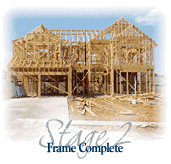
2. Stage 2: In the next stage
of 'elaboration', you lay the foundation and the frame so that the house
has a solid architecture and support.
Usually
needs inspections (testing) during this phase because if things are not
up to code you have to repeat (iterative).
3. Stage 3: is where the
real construction takes place - drywall, the insulation, doors, windows,
cabinets, painting all need to be put into place.
It
is important to stress that a lot of interaction will take place between
the stakeholders( home owners) to figure out what colors, what kind
of
cabinets, doors windows they want. People tend to change their minds
during this phase even if they agreed to something different
earlier.
Communication/Collaboration is key.
4. Stage 10: Final inspections
are done to ensure house is to code etc. The stakeholder needs to sign
off on it as being ready to use..
-
Inception/BluePrintElaboration/Stabilizing
Construction/BuildingTransition/Ready to
move in (requirements
the architecture
the house
(in production and for use)
know what you want)
(foundation
(drywall, doors,
windows)
and the frame )